Water problems don’t always look like problems at first. A faint metallic taste in a glass. A white ring around a faucet. A coffee machine that seems to collect scale faster than it used to. In a commercial building, the signs can be even easier to overlook because there are so many other things demanding attention.
Yet water quality quietly affects a lot of what happens every day. It touches plumbing, appliances, cleaning, food preparation, equipment performance and, in some businesses, the customer experience itself.
The sensible approach isn’t to assume every water supply needs the same treatment. Start by understanding the source, identify the actual concern, and then choose equipment that fits the situation.
Private Wells Need Their Own Strategy
Homeowners who rely on private wells have a little more responsibility when it comes to understanding their water. Unlike municipal systems, a private well isn’t managed by a public utility that routinely monitors the household supply.
That doesn’t mean well water is bad. Far from it. Many households enjoy excellent well water. But groundwater can contain naturally occurring minerals, sediment, iron, manganese, sulfur compounds and, depending on local conditions, microorganisms.
Good well water treatment begins with testing rather than assumptions. A water test can help identify what is actually present and provide a clearer picture of which treatment technologies might make sense.
Hard Water Can Follow You Indoors
One of the most common water-quality issues in both residential and commercial properties is hardness.
Calcium and magnesium are naturally occurring minerals, and when they are present at higher concentrations, they can leave scale on fixtures and inside water-using equipment.
At home, that might mean cloudy shower glass, spots on dishes and buildup around faucets. In a commercial environment, the consequences can be more expensive.
Water heaters, dishwashers, boilers, coffee equipment and other appliances can all be affected by mineral buildup.
Commercial Properties Have Different Demands
A business doesn’t use water in quite the same way a household does.
A restaurant may have heavy water demand during lunch and dinner. A hotel can experience large surges in the morning. A manufacturing facility may require consistent water conditions for a particular process.
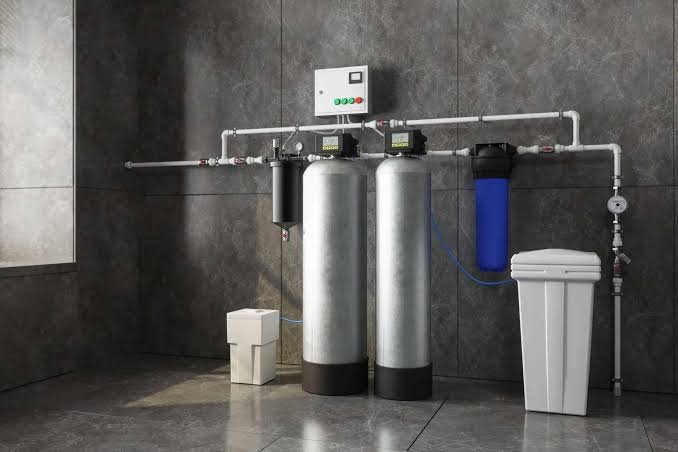
This is why commercial water softeners need to be selected according to actual demand rather than simply the size of the building.
Flow rate, peak usage, hardness level and equipment requirements all matter. A system that performs perfectly in a small office could be completely inadequate for a busy restaurant.
The goal isn’t simply to soften water. It’s to do so reliably when the business needs it most.
Drinking Water Can Require More Precise Treatment
Not every commercial water concern is related to hardness.
Businesses may also care about taste, odor or dissolved substances, especially when water is used for drinking, cooking or beverage preparation.
Restaurants, cafés, offices, healthcare facilities and hospitality businesses may all have different reasons for considering advanced filtration.
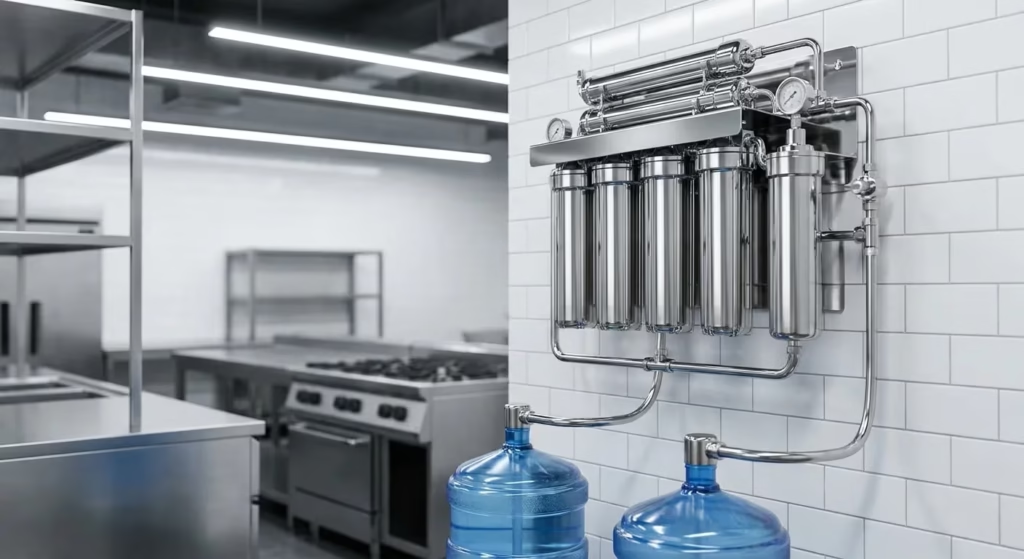
Reverse osmosis is one option for applications where reducing dissolved substances is important. The technology uses pressure to push water through a semipermeable membrane, allowing treated water to pass while reducing many dissolved materials.
When Commercial RO Makes Sense
Commercial RO filtration can be particularly useful when a business needs a higher level of water purification for specific applications.
A restaurant might use treated water for beverage preparation or ice production. A café may care about how water affects coffee equipment and flavor. A manufacturing process may require water with specific characteristics.
But reverse osmosis isn’t automatically the best solution for every business.
The incoming water should be tested first. Pretreatment may be necessary to protect the membrane, and the system needs to be sized around actual demand.
There are also maintenance requirements. Filters and membranes need periodic replacement, and the equipment should be monitored to ensure it continues operating properly.
Filtration Has a More Focused Role
Sometimes a business doesn’t need a complete purification system. It may simply need to reduce sediment, improve taste or manage a specific water characteristic.
That’s where conventional filtration can be useful.
Sediment filters can capture particles before they reach sensitive equipment. Carbon filtration is commonly used to improve certain taste and odor concerns.
The important part is choosing the filter based on the problem. A sediment filter isn’t designed to remove dissolved minerals, and a carbon filter isn’t a universal solution for every contaminant.
Water testing should guide the decision.
Protecting Equipment Is Part of the Calculation
Water treatment is sometimes viewed as another expense on a long list of business costs. That’s understandable.
But it’s worth considering what poor water conditions may cost over time.
Scale and sediment can contribute to maintenance issues, reduce efficiency and potentially shorten the useful life of equipment. If a business depends on water-heavy equipment every day, even small performance problems can become expensive.
Treatment doesn’t eliminate the need for maintenance, but it can be part of a broader strategy for protecting valuable assets.
Maintenance Can’t Be an Afterthought
Commercial treatment systems operate under demanding conditions, so maintenance needs to be planned.
Filters eventually become loaded. Softener systems need servicing. Reverse osmosis membranes need replacement. Pumps, valves and connections may require inspection.
Businesses should keep service records and know when each component was last checked.
Waiting until water quality becomes noticeably poor isn’t always the best approach. By then, the equipment may already have been operating below its intended performance.
Preventive service is usually less disruptive than emergency repair.
Water Pressure and Flow Matter Too
A treatment system has to work with the building’s plumbing, not against it.
If filters become clogged, pressure can drop. If equipment is undersized, the system may struggle during periods of high demand.
Flow requirements should therefore be considered before installation. The system needs to provide the necessary treatment without creating an unwanted bottleneck.
This is particularly important for larger commercial properties where multiple fixtures or pieces of equipment may operate at the same time.
One Building Doesn’t Always Need One Treatment Method
A property can have several different water needs.
A restaurant may require softened water for dishwashing while using reverse osmosis for beverages. An office may need simple filtration for drinking water. A manufacturing facility may require specialized treatment for a production process.
Trying to force all of these applications through one technology isn’t necessarily efficient.
Sometimes a combination of systems is the more sensible choice, with each piece of equipment doing one job well.
Start With Information, Not Equipment
Whether you’re dealing with a private well at home or managing water treatment for a commercial property, the basic principle is the same.
Test first. Understand the water source. Identify the actual problem. Consider how much water is being used and when demand peaks. Then choose equipment based on those facts.
That’s a much better strategy than buying a system because it has the longest feature list or the biggest tank.
Water is fundamental to everyday life and business, but good water management doesn’t need to be complicated. With the right information, appropriate equipment and regular maintenance, many common water problems can be handled before they become major headaches.
And when the treatment system is doing its job quietly in the background, nobody has to think much about it. That’s often the best outcome of all.