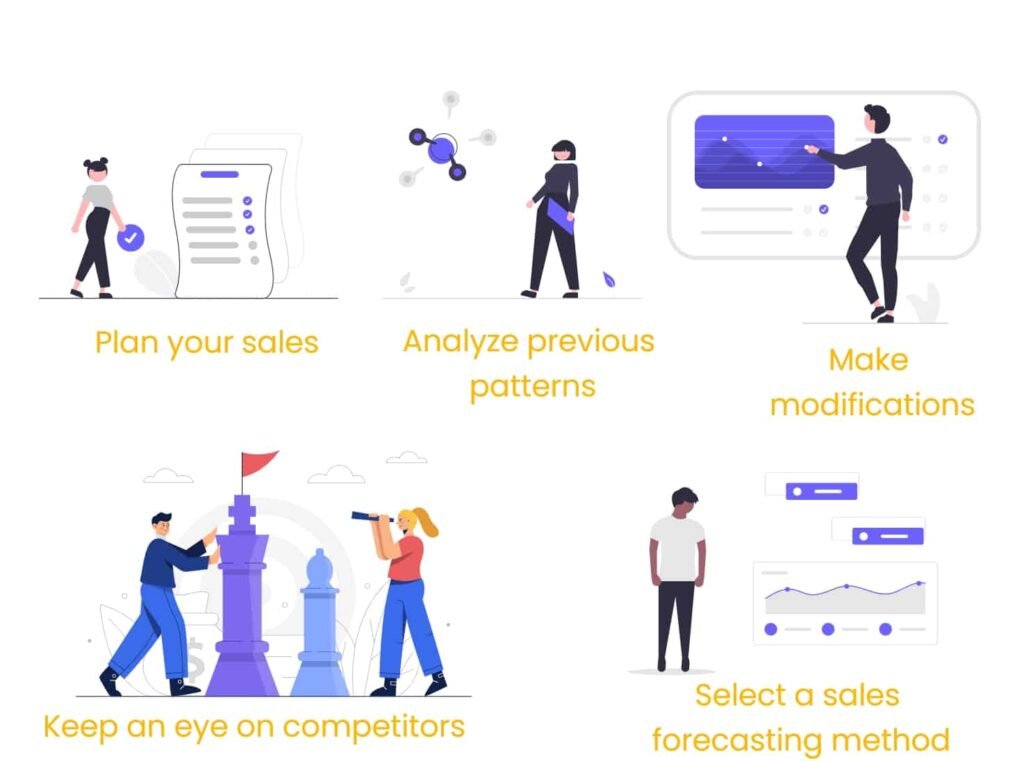
Ask ten business owners how they predict next quarter’s revenue, and at least half will admit — often sheepishly — that it’s basically a gut feeling dressed up in a spreadsheet. Real sales forecasting methods exist precisely to replace that guesswork with something more reliable, and honestly, most of them aren’t as complicated as they sound.
I’ve noticed businesses that forecast well tend to make better hiring, inventory, and spending decisions across the board — it’s not just a sales team exercise, it affects everything downstream.
What Sales Forecasting Actually Does
Quick answer: Sales forecasting is the process of estimating future sales revenue based on historical data, market trends, and current pipeline activity — used to guide budgeting, staffing, and inventory decisions across the business.
Historical Forecasting: The Simplest Starting Point
This method looks at past sales data — same period last year, or a rolling average of recent months — to project future performance. It’s straightforward and works reasonably well for stable businesses without major disruptions.
Picture a small retail shop in Jaipur that consistently sees a 25% sales bump every Diwali season. Using last year’s actual numbers, adjusted slightly for growth trends, gives a reasonably reliable forecast without needing complex modeling.
Pipeline-Based Forecasting
Quick answer: Pipeline-based forecasting estimates future revenue by looking at deals currently in your sales pipeline, weighted by their probability of closing based on what stage they’re in — a deal in final negotiation counts more heavily than one in initial contact.
- Assign a realistic close probability to each pipeline stage (e.g., 20% at initial contact, 70% at proposal stage)
- Multiply deal value by probability to get a weighted forecast
- Update regularly as deals move through stages
Opportunity Stage Forecasting
Similar to pipeline forecasting but more granular, this method breaks the sales process into specific stages and tracks conversion rates between each one. Knowing that historically 40% of qualified leads convert to proposals, and 60% of proposals convert to closed deals, lets you forecast backward from current pipeline volume.
Length of Sales Cycle Forecasting
For businesses with longer, more predictable sales cycles, this method estimates when a currently open deal is likely to close based on how long similar deals have historically taken from first contact to close. I’ve noticed this method works particularly well for B2B businesses with consultative, multi-step sales processes.
[link to related guide about b2b sales funnel here]
Test-Market Forecasting
Before a full product launch or new market entry, testing with a smaller segment first — a limited geographic area, a subset of customers — gives real data to forecast broader rollout performance, rather than relying purely on assumptions.
Multivariable Analysis Forecasting
Quick answer: This more advanced method incorporates multiple factors simultaneously — seasonality, marketing spend, economic conditions, competitor activity — to build a more nuanced forecast, typically used by larger businesses with access to more historical data and analytical resources.
Choosing the Right Method for Your Business Size
Has this ever happened to you — trying to apply a complex forecasting model meant for a large enterprise to a five-person business, and it just doesn’t fit? Smaller businesses generally get more practical value from historical and pipeline-based forecasting, while larger, data-rich businesses can benefit from more sophisticated multivariable models.
Common Forecasting Mistakes to Avoid
- Being overly optimistic about deal probability, especially with deals that have stalled
- Ignoring seasonal patterns that significantly affect month-to-month performance
- Forecasting based on outdated data instead of updating regularly
- Treating forecasts as fixed rather than revisiting them as new information comes in
Using Forecasts Beyond Just Sales Planning
Accurate forecasting doesn’t just help the sales team set targets — it directly informs inventory purchasing, hiring timelines, and cash flow planning across the entire business. A forecast that’s consistently off by a wide margin can cause real problems well beyond the sales department.
FAQ
Q: Which sales forecasting method is best for small businesses? Historical forecasting combined with basic pipeline-based forecasting usually offers the best balance of simplicity and accuracy for smaller businesses.
Q: How often should sales forecasts be updated? Monthly is common for most businesses, though businesses with fast-moving pipelines may benefit from updating weekly.
Q: What causes sales forecasts to be inaccurate? Overly optimistic probability estimates on stalled deals and outdated historical data are among the most common causes of inaccurate forecasts.
Q: Do I need special software for sales forecasting? Not necessarily for small businesses — a well-maintained spreadsheet tracking pipeline stages and historical trends works well, though CRM software helps as the business scales.
Q: How accurate should a good sales forecast be? Most businesses aim for forecasts within 10-15% of actual results, though this varies significantly by industry and sales cycle length.
Q: Can sales forecasting help with more than just revenue planning? Yes — it directly informs hiring decisions, inventory levels, and cash flow planning across the broader business.
Conclusion
Good sales forecasting methods replace gut-feeling guesses with actual patterns from your own business data — and the payoff extends well beyond the sales team into hiring, inventory, and cash planning. Start with something simple, like historical and pipeline-based forecasting, and refine it as you gather more data over time. Even an imperfect forecast, updated regularly, beats no forecast at all.
Suggested alt text: “Sales team reviewing forecasting data and pipeline charts” Suggested alt text: “Business owner analyzing sales forecast spreadsheet on a laptop”