Walk into any mid-sized company and ask five employees to explain the org chart, and you’ll probably get five slightly different answers. Corporate hierarchy sounds like a dry, obvious topic — until you’re the one trying to figure out who actually has decision-making authority over your project.
I’ve noticed a lot of confusion around this simply comes from companies mixing multiple structures without clearly communicating them. Let’s untangle it.
What Corporate Hierarchy Actually Means
Quick answer: Corporate hierarchy refers to the structured levels of authority and reporting relationships within an organization — from entry-level employees up through management, executives, and ultimately the board of directors.
The Traditional Hierarchical Structure
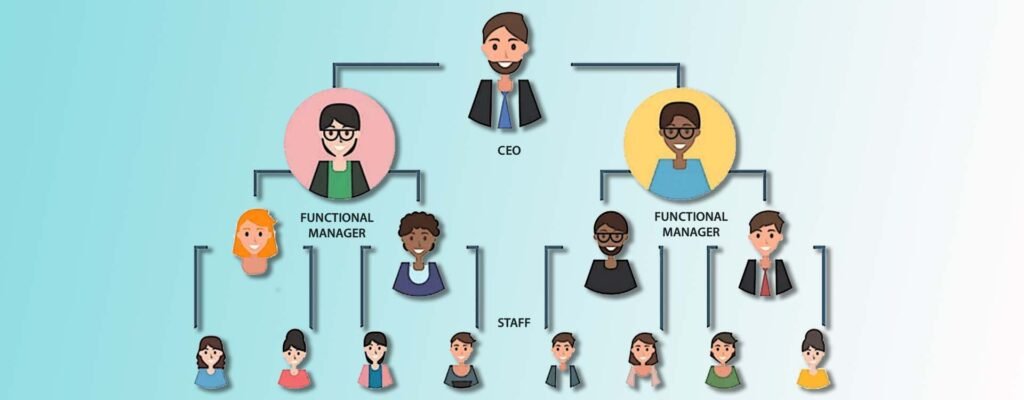
This is the classic pyramid — a clear chain of command from the CEO down through executives, middle management, and individual contributors. Each level reports to the one above it.
- Board of Directors — oversees overall strategy and accountability
- C-Suite Executives (CEO, CFO, COO, etc.) — set direction and make major decisions
- Senior/Middle Management — translate strategy into department-level execution
- Team Leads/Supervisors — manage day-to-day team operations
- Individual Contributors — execute the actual work
Picture a mid-sized manufacturing company in Rajasthan where a factory floor worker’s request has to move up through a supervisor, then a plant manager, then finally to operations leadership before a decision gets made. That’s a traditional hierarchy in action — clear, but sometimes slow.
Flat Organizational Structures
Some companies, particularly startups, intentionally minimize hierarchy — fewer management layers, more direct access between employees and leadership. This speeds up decision-making but can create ambiguity about who’s actually responsible for what as the company grows.
Quick answer: A flat organizational structure has few or no middle management layers, allowing faster decisions and more direct communication, but it can become difficult to manage once a company grows beyond a certain size.
Matrix Organizational Structure
This structure has employees reporting to more than one manager — often a functional manager (say, marketing) and a project manager simultaneously. It’s common in larger companies running multiple projects across departments, though it can create conflicting priorities if not managed carefully.
Why Corporate Hierarchy Actually Matters
It’s easy to dismiss hierarchy as bureaucratic overhead, but a clear structure genuinely helps in a few practical ways: accountability is defined, decisions have an owner, and employees know where to escalate problems. I’ve noticed that companies without any clear structure tend to develop confusing, unofficial hierarchies anyway — just without the clarity of an actual chart.
[link to related guide about corporate governance basics here]
Signs Your Corporate Hierarchy Isn’t Working
- Decisions take unusually long because nobody’s clearly authorized to make them
- Employees are unsure who to report problems to
- Multiple managers give conflicting instructions on the same task
- Talented employees leave citing unclear growth paths or reporting confusion
Has this ever happened to you — getting two different sets of instructions from two different managers on the same project? That’s a classic sign of an unclear or poorly communicated hierarchy.
How Startups Should Think About Hierarchy Early
Early-stage startups often avoid formal hierarchy entirely, and that works fine at a small scale. But as headcount grows past roughly 15-20 people, some structure usually becomes necessary just to avoid decision-making bottlenecks and unclear accountability.
Balancing Hierarchy With Flexibility
The healthiest organizations I’ve come across tend to have clear reporting lines without excessive layers — enough structure to know who owns what, without so many approval steps that simple decisions take weeks.
Evolving Hierarchy as the Company Grows
Quick answer: Corporate hierarchy should evolve as a company scales — what works for a 10-person startup will likely create bottlenecks at 200 employees, so periodic restructuring is normal and often necessary, not a sign of dysfunction.
FAQ
Q: Is a flat organizational structure better than a traditional hierarchy? Neither is universally better — flat structures suit smaller, fast-moving teams, while traditional hierarchies often work better for larger, more complex organizations needing clear accountability.
Q: What’s the difference between hierarchy and organizational culture? Hierarchy refers to the formal structure of authority and reporting, while culture refers to the shared values and behaviors within the organization — they influence each other but aren’t the same thing.
Q: How does a matrix structure differ from a traditional hierarchy? In a matrix structure, employees often report to two managers (functional and project-based) rather than a single direct manager as in a traditional hierarchy.
Q: When should a growing startup introduce formal hierarchy? Many find it becomes necessary somewhere between 15 and 30 employees, when informal coordination starts creating bottlenecks.
Q: Can too much hierarchy hurt a company? Yes — excessive layers of management can slow decision-making significantly and create disconnect between leadership and day-to-day operations.
Q: Does hierarchy affect employee morale? It can — unclear reporting lines or excessive bureaucracy often frustrate employees, while a clear, reasonably lean structure tends to support better morale.
Conclusion
Corporate hierarchy isn’t just an org chart exercise — it directly shapes how fast decisions get made and how clearly employees understand their role and growth path. Whether your company leans traditional, flat, or matrix, the goal is the same: clear accountability without unnecessary layers slowing everything down. Revisit your structure as you grow — what worked at ten employees rarely works cleanly at two hundred.
Suggested alt text: “Corporate organizational chart showing hierarchy levels” Suggested alt text: “Executive team meeting discussing company structure”